


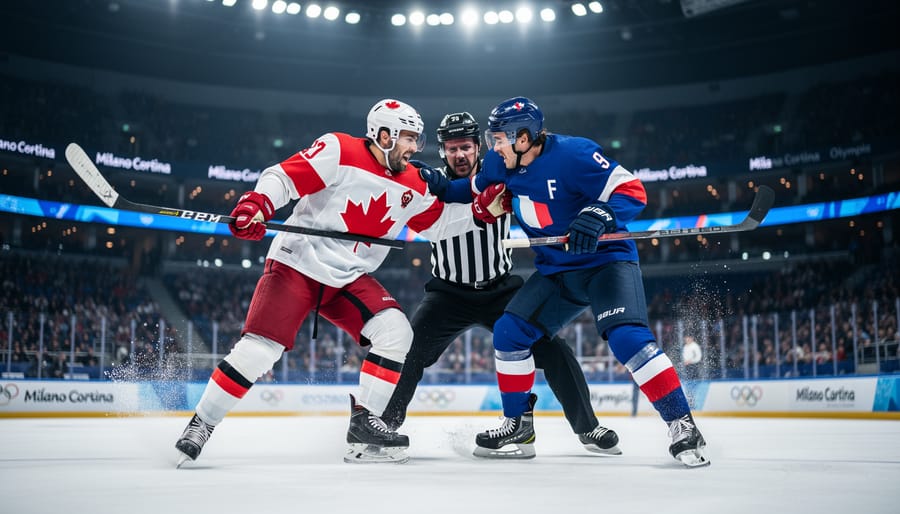
The 2026 Winter Olympics in Milano Cortina have delivered the drama Canadian hockey fans crave, but not without serious consequences. NHL players returned to Olympic ice for the first time in years, and the heightened intensity showed immediately: Kevin Fiala left Switzerland’s 5-1 loss to Canada on a stretcher Friday after a hit by Tom Wilson, requiring surgery that ended his tournament. Sunday brought another flashpoint when Wilson and France’s Pierre Crinon were both ejected for fighting during Canada’s 10-2 victory, while the U.S. stunned Canada 2-1 in overtime in a result that shifts Group A standings and betting lines heading into the medal round.
These incidents matter because they reveal what happens when the world’s best players compete for national pride rather than NHL points. The physical edge is sharper, the retaliations quicker, and the injury risk undeniable. For bettors eyeing medal futures, Wilson’s discipline record and Canada’s defensive lapses against the Americans are now live variables. Switzerland’s depth without Fiala and Canada’s ability to stay composed after back-to-back controversial games will define the knockout stage. Watch how officials manage physicality in the remaining games, whether Canada’s roster adjusts its approach, and how sportsbooks reprice futures after the U.S. upset proved this tournament is wide open.
What Changed: NHL Returns to Olympic Ice with Controversy
The NHL’s return to the Olympic stage at Milano Cortina 2026 has been anything but smooth. For the first time in several Olympics, NHL players are back competing for their countries, but the early games have been dominated by on-ice incidents rather than celebration. Within days of the tournament’s start, a serious injury, multiple ejections, and unexpectedly physical play have raised questions about how NHL-style hockey translates to the international ice.
The most alarming moment came Friday at Santagiulia Arena during Switzerland’s 5-1 loss to Canada. Kevin Fiala was taken from the ice on a stretcher late in the third period following a hit by Canada’s Tom Wilson. Switzerland announced Saturday that Fiala underwent surgery for a lower-body injury and is out for the remainder of the Olympics. The incident immediately sparked debate about the line between aggressive play and dangerous hits in Olympic competition.
Sunday brought more controversy. Tom Wilson and Pierre Crinon were both ejected for fighting during another Canada matchup that ended 10-2. Later that same day, the U.S. men’s team upset Canada 2-1 in overtime, providing a reminder that competitive hockey can coexist with physical intensity, but the disciplinary storylines have overshadowed the scoreboard.
The question now facing tournament organizers, NHL officials, and fans: Is this the inevitable result of mixing elite professional players with international rules and Olympic stakes, or a sign that something needs adjustment before the knockout rounds begin?
Major Developments from Milano Cortina 2026
1. Kevin Fiala Injured on Tom Wilson Hit, Exits Olympics
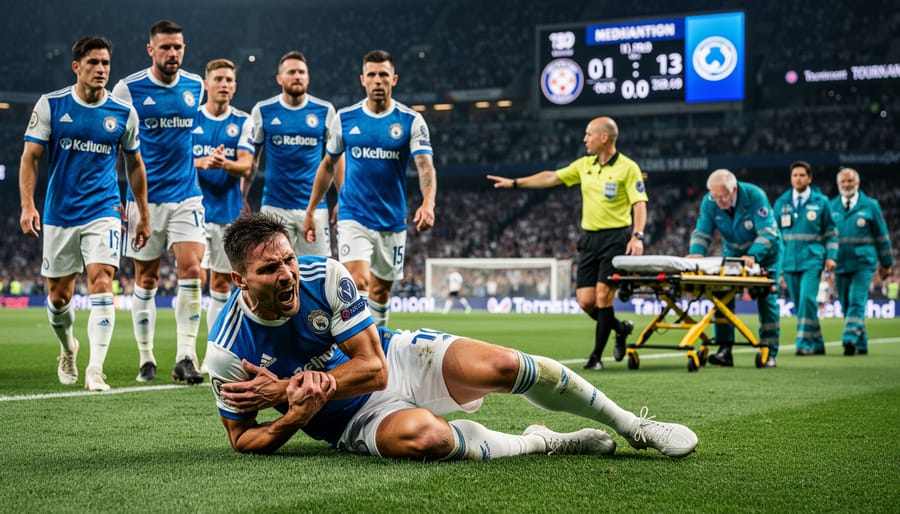
The night Switzerland was eliminated from medal contention didn’t end with a final buzzer. Late in the third period of Friday’s 5-1 loss to Canada at Santagiulia Arena, Wild forward Kevin Fiala went down after a hit from Tom Wilson and never got back up. Medical staff rushed onto the ice as play stopped. Fiala, clearly in pain, was stabilized and taken off on a stretcher while his teammates watched in silence. The arena, which had been loud with Canadian cheers moments earlier, went quiet.
What looked bad on Friday got worse on Saturday. Switzerland announced Fiala had undergone surgery for a lower-body injury and would miss the rest of the 2026 Olympics. The Fiala injured on Wilson hit incident ended the tournament for Switzerland’s top offensive threat before the knockout rounds even began.
For Swiss fans, the timing couldn’t have been crueler. Fiala entered Milano Cortina 2026 as Switzerland’s primary scoring weapon, the player expected to carry his country through a tough Group A field. Now Switzerland faces the rest of the tournament without him, their medal chances effectively over before the quarterfinals.
The hit itself has sparked debate about physicality standards when NHL players return to Olympic ice. Wilson, known for his aggressive style in the NHL, delivered a hit that looked routine by North American standards but resulted in a devastating injury on the larger international rink. Whether the play warranted supplemental discipline is a question Olympic officials didn’t pursue, but the result speaks for itself: one of Europe’s best players watching from a hospital bed while the tournament continues without him.
2. Tom Wilson and Pierre Crinon Ejected for Fighting
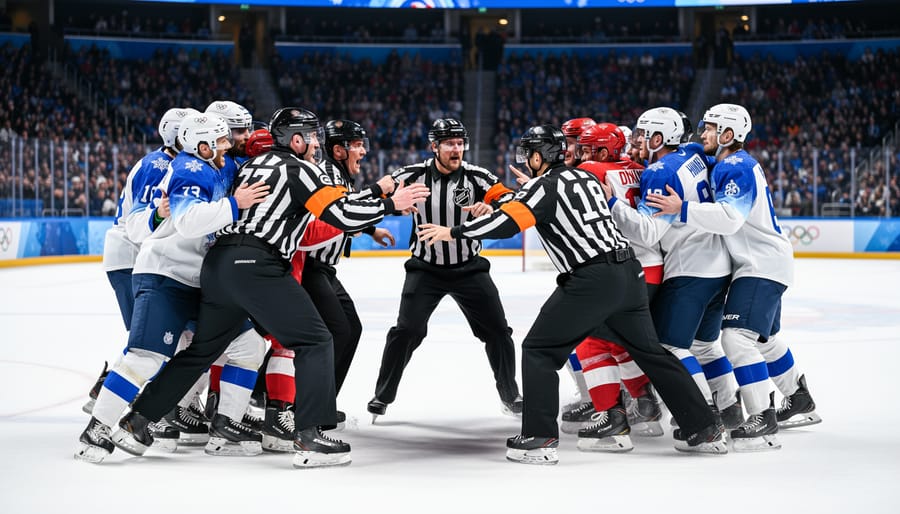
Two days after the Fiala incident, another Canada game erupted into controversy when Wilson and Crinon ejected for fighting during Sunday’s lopsided 10-2 Canadian victory. The altercation marked the second time in three days that Wilson’s physical play drew major penalties, raising questions about how Olympic officials would handle the NHL’s culture of on-ice physicality.
Unlike the NHL, where fighting typically results in five-minute majors and players returning to action, Olympic rules carry stricter consequences. Both Wilson and France’s Pierre Crinon received game ejections and automatic one-game suspensions for the fight, sending a clear message that IIHF standards differ significantly from North American professional hockey norms.
The ejections came during a game Canada was already dominating, but the disciplinary response signals that Olympic officials won’t tolerate the scrums and retaliatory exchanges common in NHL play. For Canadian fans accustomed to Wilson’s aggressive style in Washington Capitals games, the swift ejection demonstrated how quickly international rules can sideline key players during short tournament windows.
The incident also highlighted a broader tension: NHL stars bring intensity and star power to Olympic hockey, but their physical game doesn’t always align with international ice dimensions and European officiating philosophies. With knockout rounds approaching, teams face a delicate balance between playing the hard-nosed style that works in the NHL and avoiding penalties that could cost them medal chances.
3. Team USA Upsets Canada in Overtime Thriller
In a stunning reversal of form following their 10-2 demolition of the field earlier in the tournament, Canada fell to the United States 2-1 in overtime on Sunday in what stands as the marquee upset of Group A play. The result fundamentally altered the competitive dynamics of the group, proving that Canada’s dominant early showing wouldn’t guarantee a smooth path to the knockout rounds.
The overtime thriller came just hours after the Wilson-Crinon fighting incident in another Canadian game, capping a weekend where Canada’s physical dominance didn’t translate into consistent results on the scoreboard. The Americans capitalized on their opportunities against a Canadian roster that had previously looked unstoppable, exploiting the tighter checking and more structured defensive systems that define Olympic ice.
From a tournament perspective, the U.S. victory injects genuine uncertainty into Group A standings. Canada’s path to a favourable knockout-stage matchup now depends on how they respond in subsequent round-robin games. For Switzerland, already reeling from the Fiala injury, the American upset offers a silver lining: if the U.S. can beat Canada, the group remains competitive despite the loss of their top offensive weapon.
Canadian sports bettors who had written off the American squad as a non-factor will need to recalibrate their assessments. The overtime result demonstrates that NHL talent depth matters more than any single blowout performance, and that Olympic tournament dynamics reward teams who can execute under pressure when games tighten up.
4. Physical Play Raises Questions About Olympic vs. NHL Standards
The collision of NHL physicality with Olympic hockey is creating visible tension on the ice at Milano Cortina 2026. International rules technically prohibit the same level of body contact permitted in the NHL, and the wider Olympic ice surface, 15 feet broader than North American rinks, traditionally favours speed and skill over grinding battles along the boards. Yet with NHL players returning after years of absence, the game’s tempo has shifted noticeably more physical, catching some officials and teams off guard.
The Wilson-Fiala hit and subsequent fighting ejections highlight this clash. While such plays might draw a penalty or even suspension in the NHL, they’re creating a different dynamic in a tournament where international federations typically emphasize player safety more strictly than North American leagues. The question now is whether officials will tighten enforcement to restore traditional Olympic standards or accept that NHL participation brings its own brand of hockey, harder hits, more edge work, and a willingness to answer physicality with physicality.
Why These Incidents Matter
These early incidents have ripple effects far beyond a single tournament. The violent collision that sidelined Fiala and the subsequent ejections for fighting expose fundamental tensions between NHL-style play and Olympic ice. For Canadian fans and bettors tracking the Games, here’s what matters:
- Tournament competitive balance shifts immediately, Switzerland loses a star forward just as knockout rounds approach, opening opportunity for underdogs and changing medal futures.
- The NHL-IIHF relationship faces renewed strain around officiating standards, physical play enforcement, and whether the league will commit players to future Olympics if injuries mount.
- Insurance and contract concerns resurface as GMs watch multimillion-dollar assets leave Olympic ice on stretchers, potentially affecting willingness to release stars in 2030.
- Betting lines adjust in real time as rosters change and discipline creates lineup uncertainty, sharp bettors gain edges by reacting faster than books reprice props.
- Discipline precedents get set here that could influence how international tournaments handle NHL player incidents going forward, bridging the gap between playoff intensity and Olympic restraint.
The Fiala situation resonates especially in Canada because it mirrors concerns from past Stanley Cup incidents where hits deemed clean by NHL standards triggered scrutiny under different contexts. Olympic stakes raise the bar for what’s acceptable. When fight outcomes or injury-causing plays dominate headlines, they overshadow medal races and force difficult conversations about player safety versus competitive authenticity. Canadian sportsbooks are already recalculating futures as teams adjust to missing players and altered chemistry. The incidents matter because they test whether this NHL-Olympic reunion can survive its own physicality.
What to Watch as the Tournament Continues
As the Milano Cortina tournament moves toward the medal rounds, several critical storylines will shape the competition. Discipline is the immediate question: will Olympic officials continue to eject players for fighting, or will they adjust enforcement as teams ramp up intensity in elimination games? The Fiala injury has already prompted debate about whether NHL-caliber physicality belongs on Olympic ice, and how teams like Canada balance aggression with avoiding costly suspensions could define the knockout stage.
Switzerland faces an uphill climb without Fiala, who was their top offensive threat. His absence likely drops them from medal contention to longshot status, reshaping Group A dynamics and potentially opening paths for teams like Finland or Czechia to advance. Watch how Switzerland adjusts its lineup and whether they lean more heavily on goaltending to compensate.
For Canadian fans wondering what to watch next the U.S.-Canada overtime result suggests Group A remains wide open despite Canada’s dominant wins over lesser opponents. Teams are still feeling out how physical they can play without crossing into ejection territory, which means early knockout games could see either cautious restraint or an explosion of pent-up aggression. Monitor how referees handle borderline hits in the quarterfinals, that will set the tone for the medal round.
Common Questions About NHL Players at the Olympics
Are NHL players insured for injuries during the Olympics?
Yes, NHL teams carry insurance policies that cover player salaries if injuries occur during international competition, including the Olympics. However, the coverage details vary by team and contract, and losing a star player mid-season still creates significant on-ice challenges regardless of financial protection.
Do Olympic suspensions carry over to the NHL regular season?
No, Olympic disciplinary actions are handled separately from NHL consequences. A player ejected or suspended during Olympic play can return to their NHL team without additional penalty once the Games conclude, though the league may review particularly severe incidents independently.
Why did the NHL skip previous Winter Olympics?
The NHL sat out the 2018 and 2022 Winter Olympics primarily due to disagreements over schedule disruption, travel costs, insurance arrangements, and compensation for halting the regular season. The 2026 participation marks a renewed agreement between the league, players’ association, and Olympic organizers.
How do Olympic injuries affect NHL teams for the rest of the season?
When a player suffers a tournament-ending injury like Kevin Fiala’s, their NHL team must adjust lineups and potentially seek roster replacements while navigating salary cap constraints. The timing matters too, injuries sustained in February can derail playoff pushes or force organizations to reshape their postseason strategies.
These incidents have also sparked questions about whether the physical NHL style meshes well with international ice dimensions and Olympic officiating standards. Canadian fans watching the tournament should understand that while the on-ice product features familiar NHL stars, the rules enforcement and game flow can differ from what you see during the regular season. Bettors evaluating game lines need to account for these variables, particularly when assessing teams that have lost key contributors or adjusted their playing style after early disciplinary issues.
The NHL’s long-awaited return to Olympic ice at Milano Cortina 2026 has delivered high-stakes drama from the opening puck drop, but the headlines have been dominated by injuries, ejections, and physical play that’s sparked debate about where the line sits between international competition and NHL intensity. Kevin Fiala’s tournament-ending injury, the Wilson-Crinon fight ejections, and Team USA’s overtime upset of Canada have all reshaped the competitive landscape in ways that matter whether you’re cheering for hardware or weighing live-betting opportunities.
As the knockout rounds approach, keep your eye on how teams adjust their physical strategies, which rosters are thinned by discipline or injury, and how officiating standards evolve under the spotlight. The Cheap Seats will continue tracking every development with the sharp analysis and Canadian sports betting insights you need to stay ahead of the action, because this tournament is proving that when NHL talent meets Olympic stakes, anything can happen.